Practice on-board Toyoshio Maru

Hello!

On the 5th of august we had the opportunity to do some on-board practice on Toyoshio Maru, Hiroshima University’s research vessel. TM is built in 2006 and is used as a training vessel by the Graduate School of Biosphere Science, Hiroshima University. Toyoshio Maru is travelling around the Seto inland, western parts of Japan and sometimes as far as Korea.

The day was hot and the sun was shining when we left the hotel by bus. I think we were all tired because of the long and intense day we had the 4th with presenting our country reports and participating in the welcome ceremony held at Hiroshima University.

The japanese students were already familiar with Toyoshio Maru since they are using the boat for their research. We borrowed rubber boots and on board we had some ”safty instructions” ☺ and were told to always use helmet and life vest when being on the deck. Me and Kevin had also noticed that a lot of people in Japan wear a small towel around their neck because of the heat. So, equipped with rubber boots, life vest, helmet and sweat towel we were ready to start our research trip!

The trip was mostly about getting a presentation of TM and see if there was any significant difference of the environmental status between two locations in Hiroshima bay. Among the tests we conducted were CTD, pH, sediment tests and identification of benthos and planktons. I appreciated the more practical approach during the day because it’s always easier to get to know each other when working together.

In the afternoon we were all really tired. Me, Kevin, Mickey (from Ritsumeikan Asia Pacific University) and Vane (from Rovira i Virgili University) decided to have dinner at a restaurant in Saijo. We got stuck at the local YOUME that is a large supermarket center located about 15 minutes walk from the Green Hotel Morris. At YOUME we found a restaurant called the Casual Viking (!) which had buffé with as many japanese courses as we could figure out. The japanese food really is something special. All these flavours and textures some unfamiliar to me but oh so delicious!

/Linnea

The memory of an atomic bomb


DSCN3183


On the 6th of August 1945, the atomic bomb was dropped over central Hiroshima city. Amidst all our adventures, it becomes easy to forget that this is the reason we are here. During the past two days, the city of Hiroshima has displayed an exceptional spirit of solidarity – trying to remember the victims killed by the A-bomb – as well as to spread the message of peace to the rest of the world.


The people of Hiroshima have also shown that not only is this a time for locals to come together and remember the day of the bomb, but it is also a time to convey an understanding to others of what happened that day. Mr. Keijiro Matsushima, one of the survivors of the A-bomb (a group called Hibakusha), told us the story about his life in Hiroshima and that fateful day when the place he called home was obliterated. Needless to say, this was an incredibly unique experience that will remain in the memories of all participants. We were impressed by Mr. Matsushima’s gentle manners and lack of resentment, as well as his candid account of the misery caused by the bomb.

Mr. Matsushima

Mr. Matsushima


Japan's Prime Minster, Shinzo Abe

Japan’s Prime Minster, Shinzo Abe

Following Mr. Matsushima’s speech, the next day demanded an early awakening for all of us, as we got up to participate in the Hiroshima Peace Memorial Ceremony. Speeches from Prime Minister Shinzo Abe, the mayor, UN representatives and the Children’s Representatives were coupled with the release of peace doves and the dramatic sound of the Hiroshima Peace song performed by a children’s choir and orchestra.

IMG_7885


On a happier note, the day carried on the island of Miyajima. In the intense heat, we strolled amongst the wild deer, walked through a Samurai temple, and snapped an abundance of pictures of the Itsukushima Shrine.


That, however, would turn out to be nothing in comparison to the amount of photos produced during the Lantern Ceremony later that night. It is held annually to remember the victims of the A-bomb. As the sun set on the river running through central Hiroshima, hundreds and hundreds of lanterns were lit, shining against the backdrop of the A-bomb Dome (one of very few buildings that actually remained after the attack).

The A-bomb Dome during the Lantern Ceremony

The A-bomb Dome during the Lantern Ceremony

We have arrived!

We have arrived

My name is Kevin Malmborg, I’m 20 years old and I study environmental science at Malmö University. Environmental issues were not always of interest to me however with time I came to realize the importance of global engagement and responsibility.

I’m in my little brown hotel room (brown carpets, furniture, bed, wall and kettle, everything is in some shade of brown) ready for the INU 2013 summer school on global environmental sustainability.

Through my window I can see the tree covered hills hidden behind huge monotone concrete blocks surrounded by heavily corroded fences, gates and light posts. Japan is a humid country therefore the steel skeleton of which our unsustainable society is made of quickly rusts; the rust however is a quiet pleasant red-brown color, better than my hotel room.

An Eventful and Memorable first day of the Seminar

Today was the first day of the Student Seminar on Global Citizenship and Peace for us undergrad students. We started this week off with a special emphasis on peace, spending two days commemorating the tragedy of the destruction of Hiroshima caused by the atomic bomb on August 6th 1945. I write my first blog post with a certain blend of awe and exhaustion.

As part of our reading assignment, we had to read Hiroshima by John Hersey, which was published in the New Yorker one year after the bombing; a whole edition dedicated to the documented story. Naturally, I had started to read this a few weeks ago, but in a certain sense I didn’t quite feel properly prepared for it. I was mentally occupied with work, planning the practical details for this trip and I felt like I needed to give this piece of literature the respect and time it deserved. Therefore I read the rest when I took the Shinkansen from Tokyo to Hiroshima yesterday. As I sat in the airplane-like seat, facing no one and sitting side by side with my fellow passengers, I couldn’t help shaking with muffled sobs. As anyone would, I imagine. First of all with the intense feeling of the human suffering that occurred. Which is unfathomable in its seemingly unending horror. But then, also this other dimension: of unity in the most trying of times, the strength of the people of Hiroshima and the power of reconciliation. It felt eerie to be taking this superhuman train into what was once a nightmare scenario for so many people, now an international symbol of world peace. I just felt purely overwhelmed that I was not only going to attend the Memorial Ceremony, but also to be in the presence of a Hibakusha, a survivor and direct eye witness of the destruction in 1945 and blessed with the privilege of hearing his account. Although I’d been imagining this for a few months, I just still couldn’t believe the reality of it.

So today, after a brief introduction to our course and a Japanese language session for the most essential phrases taught by a very passionate language student, we met inour Country Groups to get acquainted. We then took off to the Chamber of Commerce where we heard the personal account of Mr. Matsushima who was only 16 years old on that fateful day. Despite having told his stories many times in the spirit of remembrance and sharing, he still spoke with clarity, humour and compassion. His English was very impressive, which I was told he had taught himself so that he could also be able to share his experience directly with foreigners. He kept repeating how lucky he was to have survived, as many near him, essentially meters away, unfortunately didn’t. 

Afterwards, we walked through the Peace Memorial Park, where the Atomic Bomb Dome mysteriously and symbolically still stands tall despite being very close to the epicentre of the explosion. It was a crowded area and animated with music from across the river. It was strange to imagine how close to the epicentre this area was and I spoke with many students who were equally touched. Farther along we entered the Peace Memorial Museum alongside students of all ages from all over Japan. There was loads of information on the history of the war, the technicalities of nuclear energy, the details of the destruction. This was enhanced by items found in the ruins. I think that a lot of visitors saw one or two things that they will personally never forget. It got to me when I saw the completely burned, disfigured and rusted little tricycle that belonged to a 3-year-old boy who apparently always biked around. He died as a result of his burns, and was buried with this beloved tricycle, until it was dug out about 40 years later and given asa donation to the museum.

In this sense, it was an intense day for all of us. Walking the ground that once burned 3000´C, retracing history with the help of Mr. Matsushima, shaken with images of human suffering. And at the same time, it was also the first day of our seminar and we were eager to get to know each other. All day was spent talking to new people. I listened eagerly to many stories; of how women are treated in Japan, how WWII is taught in American High Schools, and what it’s like to work and live in Cambodia.

I’m sure everyone else felt overcome with emotion and information just like me, because when we came back to our area around 8 pm and went shopping in our local 7/11 for a quick dinner, all the other students I met were also sort of staggering around. Now I sit here on my bed exhausted and worried whether I’ll miss my alarm tomorrow. In order to be at the Peace Memorial Ceremony, we are all meeting up outside at 5.50. I better drift off before I get too excited.

PS: I should perhaps add that I highly recommend anyone to read Hiroshima, if they haven’t had the chance already. The full text is available online.

10 PM, August 5th 2013

– Sarah


Mr Matsushima surrounded by INU students

Mr Matsushima surrounded by INU students

Teaching the new generation about the destruction caused by war - the Dome can be seen in the background.

Teaching the new generation about the destruction caused by war – the Dome can be seen in the background.

Another image from the museum of the totally flattened city

Another image from the museum of the totally flattened city

Voluntarily Lost in Translation


DSCN2839

We mingled with Scarlett and Bill in the Tokyo Park Hyatt where Lost in Translation was set

After very nearly deleting the e-mail from the international office in Malmö, dismissing it as spam (the subject was: ‘CONGRATULATIONS’), I got an excited, correction over-excited call from my course friend (and real-life friend) Caroline proclaiming that we both got INU Summer School scholarships to go to Japan. Japan! Wow. The country conjures up contrasting images of traditional houses, powerful geishas, delicate temples and incomparable green nature onto a backdrop of colourful anime, cutting edge technology and competing neon signs. Which Japan would we find? We headed to Tokyo a week before the school started to find out.


DSCN2480

Cute (evertything in Japan aspires to be cute or Kawaiii) hints on how to behave on the metro

Landing in a city of 14million when you’re used to 300,000 strong Malmö you’re mentally prepared for chaos and being permanently lost. But we found that although the metro map looks like colourful spaghetti and there are multiple railways companies owning various lines on the metro, everything is amazingly logically planned. Most signs are in English, colour coded and numbered.

IMG_7426


DSCN2638

Commuters

If you ever find yourself lost and can’t speak Japanese then gesture where it is you want to go and the upmost will be done to make sure you get it! Form what we experienced Japanese people are very private and great lengths are gone to not be an inconvenience to others for example


no-one pushes or shoves on the metro, no-one coughs, space is made for everyone with minimal touching and there is absolutely no loud talking on the trains. Maybe it’s these principles that make it possible to have such a high concentration of people without it spilling over into chaos?


DSCN2562

Smiles all round in Ginza, Tokyo’s playground for the rich and fancy (and us for a night).


Not knowing Japanese many of our experiences happened by chance. We adopted the habit of just pointing at random things on the menu and hoping for the best (all yum!). Much of the action if hidden from street view in Tokyo either underground (cooler and saves space) or up high in department buildings. So if you can’t read Japanese you can’t read the billboards advertising what’s inside but nothing stops you from taking the steps down to see what yummy restaurants can be sampled there, or going up to find men playng betting flipper in a trance (Pachinko). Fancying a cocktail in late night Ginza we acted on the ‘press a random button in the lift’ tactic and ended up in a bar- where the staff were as surprised to see us as we them! After initial excitement and confusion we all got into some old fashioned karaoke (we murdered Country Road), we all exchanged details and mingles with the suits and kimonos.


DSCN2455

Tokyo is a sensory overload with music blaring, bright colours and many new things for a Malmö accustomed brain to take in and understand. But maybe understanding shouldn’t be the objective- go with the flow, press the lift buttons and if you get lost there will most likely be a Japanese person who will politely help you out.

The first days in Hiroshima!

Phew!

Welcome everybody! After an action packed week in Tokyo with my fellow student Sofia Wachtmeister, we took the Shinkansen (the fastest train in the world!) to Saijo, Hiroshima. And there is certainly no rest for the wicked!

IMG_7753

So far the Master’s Summer School on Global Citizenship and Peace has introduced us to a wonderful group of people, all of different national origin and with different stories of life. Except for us Swedes, the other students are from Indonesia, South Korea, Italy, Spain, USA, Vietnam, Denmark, Australia and China.

IMG_7777

We have engaged in interesting discussions on global citizenship, tried the local cuisine (Okonomiyaki, delicious!) and started to conspire against each other for the UN role-play on Saturday.

DSCN2897

We have all prepared a paper for this week, covering one of four themes on global citizenship and peace. These are to be presented and critiqued by other members of the group. As one of the first discussant and presenter, I found that it was an enlightening experience to have such a mixed group with different background to give me feedback. At this course, we have come in contact with differing teaching styles and study techniques – due to the different backgrounds of both teachers and participants – but what we’ve realized is that despite cultural and academic differences, many of us a working towards the same goal: bettering our understanding of the world and our role in it.

At the welcoming party that was held this night, we also got a chance to mingle with participants of other groups. As these couple of days have passed, we are starting to realize that the coming week will be as intense as it will be fun!

Stay tuned for Sofia’s account of crazy Tokyo and the upcoming activities of Hiroshima!

DSCN2888

En Route

4/8, 13:30 PM

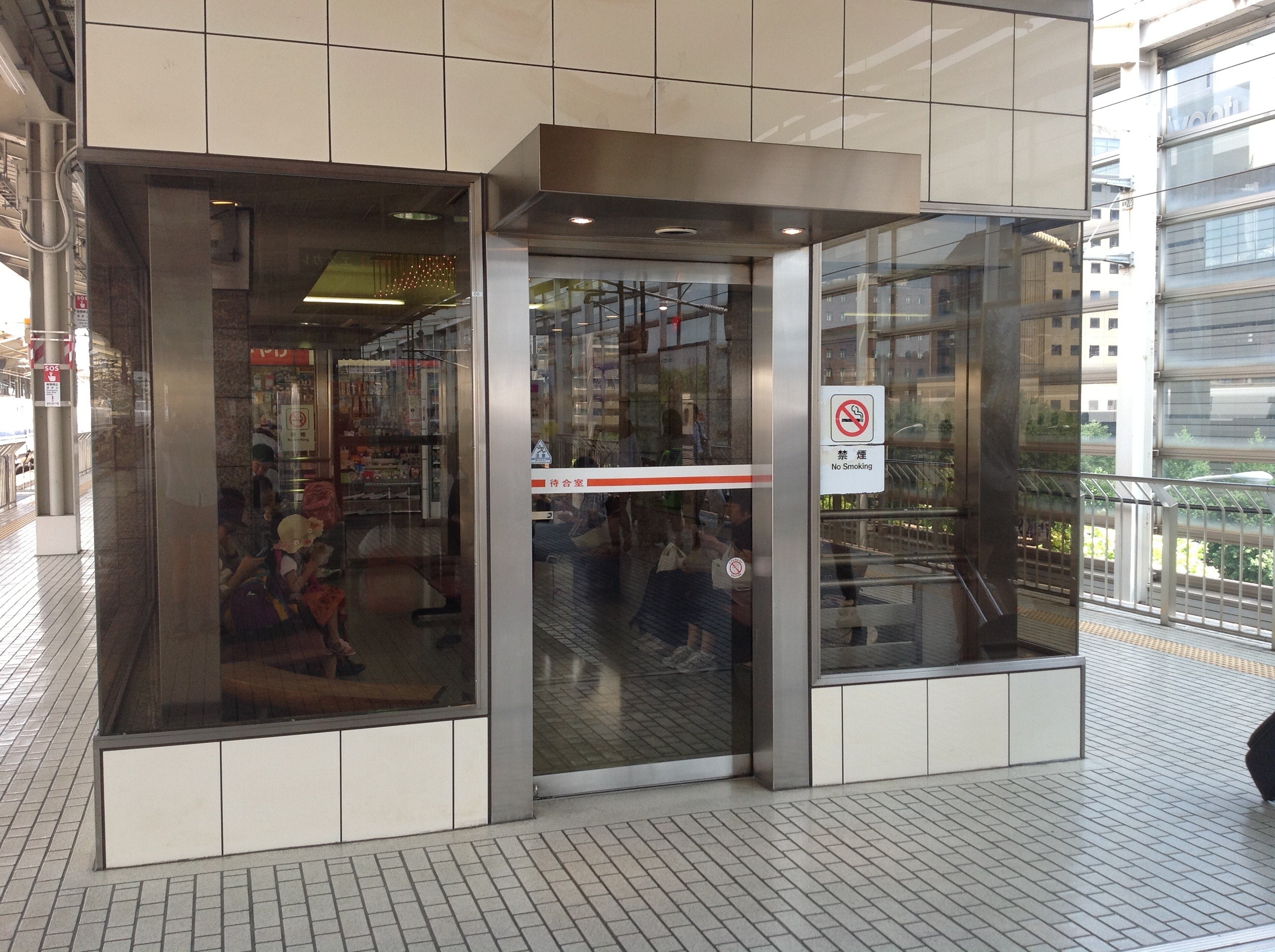
I am so glad that I have discovered the chilled waiting cubicles available on most train platforms (they are obvious once you are aware of them, but poor signage lead to most tourists suffering outside). Being cool increases the convenience of waiting for trains by a mile. Kyoto, which I have just left for Hiroshima and the INU Student Seminar commencing today, is notably hotter than Tokyo. Another way of avoiding the heat is to spend time in shops equipped with air-conditioner, something I have dedicated most of my time to do whilst in Kyoto. Despite spending countless of hours exploring almost every traditional Kyoto craft shop I must admit being a tad disappointed by the offering. If its truly traditional it’s ridiculously expensive, otherwise it’s mostly cheap kitsch. Before finding this out I bought a load of bubble wrap in the Japanese equivalent of a £1 shop (JPY 100 shop), believing I was going to wrap tons of Japanese ceramics. So potteryless I am now dragging around two huge rolls of bubble wrap. Luckily they are super light and they serve a good excuse for purchasing and wrapping loads of Japanese beer and Hiroshima made sake to bring back to the UK. With neither a decent Yukata in sight, despite looking around in second hand shops, not a classic Kyoto knife (the only REAL old knife producer, unlike many other, was closed) I have left Kyoto with barely more than a few pairs of silk socks and a mini Totoro figure (an essential buy if you love the film).

Since the temple shut their door at 9 PM, in order for the guests to wake up refreshed at 5 AM and participate in the morning ceremony, there have been no social activities late at night during my stay. Instead I have enjoyed watching the monks going about their business in the temple village and the older, more religious, demographic of Japan, who prays outside the temples in the morning. This demographic is also extremely well mannered and gives everyone they meet, without exception, a good morning greeting followed by a short bow. Therefor peaceful morning walks in the temple village was pretty intensive since you have to stop every 5 seconds in order to greet. At 7 AM a vegetarian breakfast was served in the dining hall, in accordance with Buddhist teaching of not killing any living creatures. Scattered outside the temple area is many vegetarian (and a vegan Michelin starred restaurant!) to my delight. On the note of vegetarian food, the pillow I slept on during my stay in the temple was filled with rice and must have been the most uncomfortable piece of bedding ever made. I rather sleep on my bare arms than on a bag of rice, which felt like a lump of concrete after a while.

Whilst in Kyoto I had many new culinary experiences. The vendors at the Nishiki food market happily gives away their samples and after passing through what felt like hundreds of stalls I was completely stuffed. As a green tea lover I am thrilled by all green tea filled stuff and the only food item I dislike so far is the Daifuku, filled with Azuki bean paste. I suppose you get used to them as treats if you grow up eating them, but I cannot understand the Japanese joy over Azuki bean paste. However, I have enjoyed plenty of raw egg in Kyoto. Raw egg and noodles, raw egg for breakfast and raw egg, which to be fair you later cooked yourself on a mini gas stove at your table, with rice. Will do further research if this is a typical Kyoto thing.
A final note, I really appreciate the Japanese traditional Ofuro baths I have been fortunate of having every single night before going to bed. The picture below is from my Tokyo bath but I have enjoyed a similar styled one in Kyoto as well.

Sayonara!

/ Hedvig

1.Platform cubicle, 2. Temple stay, 3. Raw egg, 4. More raw egg, 5. Bath

CubicleTemple

Raw Egg

Another Raw Egg

Bath

Impressions so far.

I (Nadja) just arrived at Green Hotel Morris in Higashi, Hiroshima. It has been a long flight for me and Lea, which is also attending this years student seminar in Hiroshima as a participant from Malmö University. Since we mostly have been stuck inside airplanes and airports before arriving at our hotel, our impressions of Japan are limited. However, the things we have noticed is that both Tokyo and Hiroshima are super clean – there is nothing left behind anywhere which even applies to the public bathrooms.

Speaking (or writing…) of japanese bathrooms, they are quite different from the swedish ones. Several colored buttons near the toilet indicate different activities such as getting sprayed with water. I have heard that some toilets also have a button for singing, which I look forward to hear, try and see!
Besides being a clean country we have only so far had great interactions with people. Even if our knowledge of the japanese language is extremly limited we have managed to buy bus and train tickets and order really good food. For a vegetarian as myself it might be a bit tricky to find the “right” food even if we have noticed that restaurants almost always have pictures of the food on the menu. Sometimes it can be hard to actually tell if a dish is vegetarian or not, but at Hiroshima airport we managed to order a completely vegetarian (at least I think it was) noodle soup. Our chopsticks skills were not satisfying since the cook gave us forks after a while. However, we will not give up our attempts to eat food in Japan the japanese way!
Now it is time for some sleep before having a japanese breakfast in the morning and exploring Hiroshima!

Konichiwa

11:33 AM

Greetings from Japan,

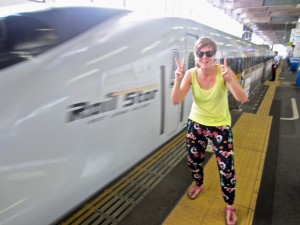
After 3 days in Tokyo I am now on the Shinkansen train towards Kyoto and I am utterly impressed with the Japanese transportation system. The trains are remarkably clean and nearly always on time (if not, you will receive the information, including an explanation behind the delay, on the live feed available on all public transport vessels), but the best must be the music played when arriving at certain stations. The tune varies depending on the stop but its generally an upbeat bitpop jingle, which always makes me smile. The purpose of these tunes is to ensure that daydreaming travellers, or sleeping commuters, wake up and don’t miss their stop.

Despite knowing about the Japanese appreciation for neat and tidiness prior to my trip, I am thoroughly amazed by the overall cleanliness. The safety of Japan stretch from the overall low crime rate to the extreme safety measures taken when public works are carried out. They usually employ a person, whom’s sole purpose is to guard the publics’ safety. The other day I was walking across the wonderful park located to my place of stay and despite walking several meters away from the park workers, who was trimming the lawn, surrounded by warning signage and blocked off by cones, I was asked by a uniformed man to kindly walk even further away from the works, in case I was going to be hit by grass. Every roadwork usually have such a guard, who simply watches the whole in case someone would remove the blockade and step into the whole. Health and safety measures to the top!

During my stay in Tokyo I have been fortunate to know people who live here, whom have guided me around town and provided answers to all my silly questions, like why people are wearing face masks (which is not, despite what one might think, to protect themselves from polluted air or bacterias, but to protect others from the bacterias oneself carries). My friends work colleague was wearing one the other day, due to a light cold, and he explained that it would be awfully embarrassing if he was to cough in the office. Good manner is also to clean your hands everywhere you go. Disinfection agent, or sanitary towels, is provided at mosts counters, such as at the post office, shop and restaurants. One does not generally eat or drink in public, again in order to show consideration for others, whom might not want to watch you eat. I made the faux pas by eating my Onigiri in public, when I should have gone to a hidden spot or a park. This could be one of the reason behind the absence of public litter. Another reason is the general prohibition to smoke outside, which the odd naughty smoker ignores. This results in no butts on the ground! Same goes for take away cups. Despite serval Starbucks I have yet not seen a single person drinking coffee from a take away cup. This also stems from the tradition of setting time aside for food and drink, it is not meant to be consumed in a rush.

However, the absence of smokers outside does not stop them from smoking inside, in connection with a meal. Whilst dining in the Ebisu area I found most people, and kitchen staff, smoking. It appears that behind the cleanness frenzy facade lies little filthy secrets. Japan is not particularly Eco friendly with little green energy and recycling.

Another backside is of the great organisational machinery, that represents the Japanese society to well. According to some non-Japanese friends it can be very frustrating for foreigners to work in Japanese companies at time. When suggesting new ideas, they are consider to have an attitude problem according to their superior managers, since it is not their place to voice opinions. As a ordinary worker, in contrast with managers higher up in the hierarchy, one is to follow all rules to precision at all times, regardless of whether the rules are efficient or not (many are not since great value is placed on the tradition of how things is to be done, which can be most ineffective at times) and without questioning. This of course results in some very good things as well, like the impeccable service one receives, or the genuine quality of production and food. To carry out ones work with the highest precision and accuracy appears to be equally important at all levels of employment. Nothing is done on a whim.

The consideration taken of others benefits me as a visitor greatly. Everyone is astoundingly polite and possess great manners. In the company of Japanese I feel terribly clumsy and rude. I have yet to learn the difference between the numerous levels of politeness when greeting, depending on to whom you speak to. The only skill I master is Japanese table manners. Despite the difficulty eating a whole fish with chop sticks I managed to wipe all the meat of the bones, for which I received paise from a Japanese friend.

If ever visiting Tokyo, make sure you stay or visit it’s old town, Yanaka, which survived both the great fire of Tokyo in the 30s and the WWII. The neighbourhood is very quaint, with a strong community feel. Before I left my traditional Ryokan, I signed the owners petition for preserving an old local tree, currently in threat of being torn down. The locals also worry a great deal about the widespread housing development in Tokyo, where the tall buildings leaves the elderly stranded on the top floors, unable to go out and about.

In a few short hours I shall join the monks and experience some zen through the daily meditation practises. At the temple I shall abide strict rules for sleeping hours, eating habits and silence. Per request my friend telephoned and organised my stay, and since there is no English spoken or website providing any information, I am somewhat nervous about not following the procedures correctly and offending the monks by doing something wrong (like sticking your chopsticks in the rice bowl is only done at funerals). However, regardless if I do or don’t they probably won’t tell me off since it would be impolite to do so. Despite Tokyo being surprisingly still, at least in comparison to hectic London where people elbow their way forward on the tube and police sirens constantly roaring, I long for the calm of the Myoshinji temple village of Kyoto.

/ Hedvig

1. Tatami, 2. Tsukiji, 3. Yanaka Cemetary, 4. Okonomiyaki

Tatami

Scallops

Yanaka

image

Breakfast at Tiffany’s…

…sadly not, though my company (Linnea) was much more good-looking than Audrey Hepburn. The food was interesting, a mix of the western styled breakfast; white bread, white buns accompanied with some strawberry jam, and the Japanese mash of ingredients colors textures and flavours.

Today we are heading out for Hiroshima; it’s time for some sightseeing,

Sayonara!

Kevin & Linnea from the INU Summer School in Japan

Hiroshima-City-Map(Map of Hiroshima City)